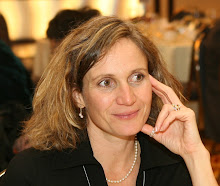
I was at IBM for 22 years ... I started on June 10, 1985 and my last day was November 30, 2007. I joined the University of Toronto Faculty of Information Studies in January 2008. I took Dec. "off" to regroup and get prepared emotionally.
I must say it was a big decision ... something I tried not to think too much about but instead went with my gut. I don't have tenure and came in at the Associate level so only have 3 years to get tenure. I try not to worry about this too much but it lurks in the back of my mind!
I joined IBM right after my undergrad but I knew I wanted to be an academic. I had also applied for scholarships and grad school. I received a Canadian gov't scholarship (NSERC Postgraduate Scholarship) that was deferrable for 2 years to go into industry so I took the job at IBM to get some experience (it was in the area of compiler development). I left after 2 years to pursue grad studies (my masters) and my (wise) manager at the time convinced me to take an educational leave of absence. I remember his reaction, “Never say never, Kelly. Things change. You’ll change,” when I told him I was never coming back. When I finished my masters and started my PhD, I went into IBM to resign but they extended my leave (that was almost 20 years ago -- I don't think it would be possible today). After my PhD, I wanted to have children and at the time looking for a faculty job seemed like a stressful process. I was offered and accepted a great job at IBM, had 2 wonderful children, and worked for 13 more years taking advantage of excellent opportunities and jobs I was given at IBM. Then (all of a sudden), I realized I had spent half my life with IBM (!) and I decided academia was now or never so I applied for academic jobs (I had built a lot of contacts in academia in Canada through my work at IBM so that helped).
And, here I am! It's pretty exciting and scarey all at once! People ask me what I miss the most about IBM and the answer is always, "the people" but fortunately, as an IBM CAS Faculty Fellow, I have the opportunity to stay in touch with and continue to interact with many of those tremendous people.
Monday, April 14, 2008
My Decision to Leave IBM

Wednesday, April 9, 2008
CASCON 2008 -- A Great Opportunity
Each year, IBM Toronto Centre for Advanced Studies and National Research Council Canada host a conference (CASCON) in Markham, Ontario. The conference is in the broad area of computer science and is considered to be the premier general international computer science conference held in Canada. It attracts international participation and over 1500 people usually attend over the course of 4 days. The first was held in 1991 and I have attended every one since. I started attending when I was a PhD student and I used the opportunity to “demo” my PhD research. The feedback I received from attendees was invaluable in the shaping of my thesis and results. I have also organized workshops and been a member of the Program Committee in the past (I’m on the Program Committee this year). In the last few years I was General Co-Chair so I’ll admit I am quite biased! But it really is a great opportunity for people whose work fits into one of the broad theme areas. Plus, it is free to attend and the lunches are delicious!
There are three main parts of the program: Academic papers (reviewed and selected by an international program committee with ~25% acceptance rate – papers are published in the ACM Digital Library); workshops and tutorials (my personal favourite part of the conference); and demos (another highlight). There are also very interesting and thought-provoking keynote speakers.
CASCON is called a “Meeting of Minds” because it aims to bring together academic researchers with practitioners and government researchers to meet and build collaborations. I highly encourage people (especially students) to take advantage of this local, free conference to showcase your work, engage in discussions, and meet new people.
You can participate as a contributor to CASCON by submitting a paper, organizing a workshop, or submitting a demo or poster. Or, you can participate as an attendee and attend any the workshops, demos, and paper presentations you wish. However, I highly recommend taking the opportunity to participate as a contributor – at least to put a poster or demo on display.
See the CASCON 2008 website for important dates, actual location, link to the call for papers, and description of topics of interest.
Monday, April 7, 2008
Great Pre-tenure Advice
I missed March!! I didn’t post anything to my blog in March. Well, technically, I did create a blog post because I set up a blog for my Service Science class where students could blog about an interesting service innovation that uses social computing technology. It was a huge success, each student blogging on something completely different. We all learned something new. So, I didn’t blog here but I blogged elsewhere.
I also missed posting something I really wanted to post about in February. On February 12, I attended an informal presentation by Professor and Vice Provost, Academic, Edith Hillan for women faculty who are pre-tenure which was hosted by her office and the Status of Women Office. It was a wicked cold day and there were fewer people there than expected but Professor Hillan delivered a great presentation, providing key tips for women faculty who are pre-tenure. She gave advice and suggestions based on her own experience and on the fact that she reviews between 100 and 150 tenure files per year. Here is what I took away from this very informative and useful event (the numbering and text are my own based on the notes I took during Dr. Hillan’s presentation):
1. Time and Task Management: she asked us to think about what we are doing to save time and provided suggestions:a. Arrange your teaching so all classes meet on the same 2-3 days per week. You are only required to teach in 2 academic terms per year so don’t volunteer to teach in your “off” time. Make it very clear to students in your class which times you are available and set clear expectations about when they can expect a response from you (eg, within 48 hours). Don’t put off doing things that look too overwhelming (eg, the exams or papers you have to mark) – get started and make progress.
b. Set limits on the amount of time you spend on each thing. Set boundaries, stick to them, and say, “NO!” if necessary. Closely organize your work week. Work in brief, regular sessions instead of binges.
c. Don’t go for perfection!! This is a tough one for me because I’ve been practising being a perfectionist for over 45 years now!
d. Don’t always answer the phone or emails – let them go to the next day, or set up specific regular time when you deal with email and at other times, don’t. I tried this when I was at IBM for a while and it really does work but it is extremely hard for me to be disciplined about this (I, by habit, check email every few minutes).
e. Do double duty (also known as “leverage”). Find opportunities where your teaching links to research and where engagements with students (both undergrad and grad) link to your research. For example, co-author papers with students, and participate in service that gives you leverage somewhere else.
f. Take your holidays. This is an important one!
2. We talked about classes and teaching and she said that student responses to teaching are important so offered the following advice:a. Make sure you are well prepared for classes. Provide good course outlines and bibliography. Present what will be covered at the start of the class.
b. Be very clear about what is expected from students (assignments, when they will be due, how they will be marked, how to contact you, etc.). She said the biggest complaint from students is that it wasn’t clear what was expected from them.
c. Leave time each lecture for student interaction and questions.
d. Take the pulse of student opinion mid-term and make adjustments. Show the students are you are interested in what they have to say. Clearly explain to students why they are completing final course evaluations and how it will affect your future.
e. Be open about your course being a “course in development” if it is one. But make sure you are able to teach courses again in the future (prepare once, reuse). Beg for and borrow course syllabi, exams, etc. from those who have taught the courses before.
3. We talked about service to the department through committees:a. Try not to do too much committee work but you have to balance being a collaborative colleague with being a productive scholar and an effective teacher. Be a good department citizen.
b. Volunteer for the things you want to do then say “No!” to the others. Don’t wait to be invited if there is a committee you want to be on – ask for it.
c. Don’t try to “run the department” until after you have tenure! Similarly, don’t get involved in outside consulting until after tenure
d. She said a good committee to be on is the “PTR” committee (Thanks to Steve, I now know that stands for "Progress Through the Ranks"). The reason this committee was considered a good one was the fact that serving on it would help you understand what is needed to progress.
a. Make statements now to put in your dossier – your “story” – where you came from, where you are now, where you are going to go, research-wise. In your research statements, explain how you are building your program and where you are going next.
b. Publish, publish, publish (I think we all knew that one!)
c. Present at department seminars and organize seminars for your department, bringing in well-known researchers.
d. Manage your professional image. Develop a “marketable” record. View tenure as a political process: meet the candidates, the voters, ensure they know and understand your message.
e. Have regular conversations with your department chair or dean. Set objectives for the year and use these discussions to get feedback on those objectives.
f. Add something to your resume / CV every month (I love this one –it’s great advice).
5. Be assertive. This is an important piece of advice for many women I know. It applies in several of the points above with respect to committees, teaching, etc. In general, ask for things – don’t wait for things to be offered to you.
Wednesday, February 27, 2008
Multi-tasking and Context-Switching
I have so many colleagues, friends, and mentors who have been in academia for years and years. They provide me with a lot of advice (almost all of it welcome) and suggestions. Just before I left IBM, one of my university colleagues told me that in academia I would find I was switching a lot between several different things -- more so than I did in industry. I remember thinking that could not be possible! At IBM, I switched between issues and topics every 30 minutes or so (back to back 30-60 min. meetings for 8 hours straight) with "sametime" (instant messages) and emails interrupting those 30-60 min. sessions for additional completely unrelated questions.
It's true that I switched more in IBM but it's also true that most of those switches were externally triggered (go to the next meeting now, respond to the urgent email request now, etc.). They were also easy to check of a list: that's done; that's done; next?
Now, I am switching between many different topics and activities (more so than I thought I would). In most cases, I have to schedule and initiate those switches. And because everything is so new, it takes me much longer to do some things than it should (or I tend to spend way too much time on some things than I should). And many of these activities are longer in duration and harder to declare as "done". Recently, in a faculty meeting, it was declared that we would meet weekly on the specific topic until we were done. A colleague remarked, "I just wish I knew what 'done' looked like!"
I actually enjoy switching between things. I have to get better at figuring out when to switch and when to keep going and, of course, when I'm "done" with something.
Thursday, February 14, 2008
What is Service Science?
So, I’ve arrived here (at the
Service science (I am using this term – others may say “service science, management and engineering (SSME)” or simply “services”) is being called an emerging discipline. There is a big push in IBM and other companies to address this area and engage with academia to do so because the services sector (vs. manufacturing and agriculture) is the fastest growing segment of the economy in most if not all nations. Because of this significant economic shift and human labour migration, there is a claim that there is a need for organizations to be more systematic about services and services delivery; therefore, there is a need for research and innovation in services and for service science research and teaching programs to emerge (See Communications of the ACM July 2006 and IBM Systems Journal January 2008.
Programs are emerging in business schools, computer science and engineering schools, and through new multidisciplinary institutions. There are a host of others.
Establishing a research and teaching program in service science requires a multidisciplinary approach. It must combine knowledge about computing and technology with the social and cultural implications of how technology will be used in a specific business or societal service domain (or service system). I’m a computer scientist at heart and a proud member of the computer science community. I am very interested in how research advances in computer science can be made in order to impact something of importance (perhaps even change the world). I am fascinated by how these advances require understanding of and participation by people and society. Therefore, service science (as I understand it) is a very exciting area for me.
Most research to date has focused on service science with an underlying assumption that the service system or service is a business / profit service. Very broadly, I’m interested in service science in which the “business” domains are not-for-profit or community organizations. Most literature today assumes the services business is a profit-making entity. I will focus on the not-for-profit and community services organizations such as libraries, museums, healthcare facilities, etc. My initial investigations show that there are many interesting problems that come up in these contexts that are not prevalent in business environments.
So, that’s a start … within this framework, I’ve identified several interesting problems that I will blog about in future posts.
Thursday, January 31, 2008
Why Blog?
My first post was easy. I wanted students to know about the course I was teaching on "service science". I had already prepared a document to help me organize what I was going to say at a meeting organized by Eric Yu for FIS students to learn about Winter 08 elective courses. The document I prepared had a bit about my background, service science, and the course. When only a few students attended the session, I decided to post the course information from that document on a blog so I could point students to the post if they wanted more information.
Since then, I've had a few ideas about what I might blog about but I've hesitated. I was still not sure why I was blogging.
My second post was about the blogging seminar I attended at the FIS Inforum (the Inforum a tremendous jewel of a resource in FIS). In that blog post, I linked to the author of a book that related to a Book Chapter I'm contributing to with colleagues at the University of Alberta. In a phone conference with them, I mentioned the book and they asked me to send the link. Instead, I sent the link to my blog post! In return, I received a thoughtful comment from my colleague and one of my academic mentors, Eleni Stroulia, to my third post in which I attempted to compare my IBM (industry) career with my (new) academic one.
Today, I had a stimulating (but too short) conversation with FIS PhD Candidate, Rhonda McEwen, about Service Science. I shared with her some of my thoughts and ideas and told her about some papers she might be interested in reading. I said I'd send the links. Then I thought, if I had just blogged about my thoughts and included the links there, I could just point her to my blog. It dawned on me that having a public repository I can point people to will help save email generation but also will make sure I don't forget to send something in the list.
Also, as I talked with Rhonda, I remembered how helpful it is (for me) to articulate my thoughts and ideas out loud. Talking out loud is a necessary step for me to know what I think (someone once told me that extroverts don't know what they think until they've said it out loud). Well, blogging is like "saying it out loud". I have just realized (although it seems so obvious) that blogging will help me know what I think.
So, two reasons to blog. Now I know "why". So, I'll start working on "how". Until next time ...
Monday, January 21, 2008
Comparing my Industry Job to my Academic Job
My first attempt at a comparison:
In my industry job, I was accountable to a large number of people and groups. I had to ensure that I was doing the things they needed: my employees, my bosses, collaborating university students, collaborating university professors, others in IBM and external to IBM, etc. A great deal of my time was spent responding to their needs or pro-actively setting up processes or systems to enable me and the rest of the organization to respond to others' needs.
In my academic job, I am accountable to less people and groups. I expect this to change as I become more active on committees, with students, collaborative research, and teach more courses but I think it will still be less than in my old job. Now, a great deal of my time is spent deciding where I should focus my effort and responding to my needs. Of course, I have high standards and needs so I push myself hard but this is definitely one difference I've noticed so far ... one that I like!